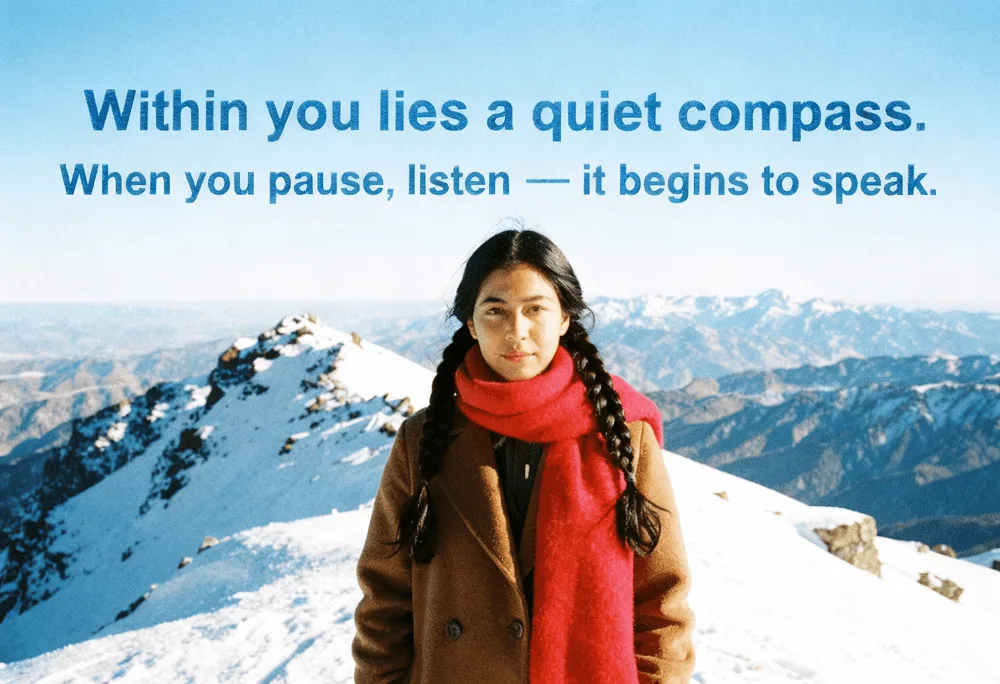
“Within you lies a quiet compass. When you pause, listen — it begins to speak.”
Often, we get pulled in many directions — tasks, responsibilities, expectations of others. In the rush, it becomes hard to sense what we truly want, what really matters to our heart. When that happens, we tend to say “yes” to everything — until we burn out or lose touch with ourselves.
To avoid that, it helps to create space for your inner self to speak. Here are four simple and nurturing practices you can use to reconnect with your inner voice — your truth, your compass — and let it guide you wisely.
1. Sacred Journaling: Let Your Words Flow
Keep a journal (a notebook or digital diary) and give yourself 5–15 minutes each day (or a few times a week) to write freely — with no editing, no judging. Just write whatever arises: feelings, dreams, worries, hopes. This kind of “stream-of-consciousness” writing can open a window to your inner wisdom. Spirituality Shepherd+2Spiritual Meanings Guide+2
Occasionally use simple prompts like: “What am I longing for right now?”, “What brings me peace?”, or “If I could make one heartfelt wish — what would it be?”
Over time, patterns may appear — recurring hopes, fears, desires — which can offer deep insight into your truth.
2. Creative Expression: Let Your Soul Speak
Try gentle, expressive activities: doodling, painting, collaging, writing a poem, dancing — whatever feels natural. You do not need to be “good” at them. The goal isn’t perfection, but expression.
Focus on the process: enjoy the strokes of paint, the swirl of lines, the flow of movement or words — and observe how you feel while creating. Sometimes, the emotional reactions you sense during the act become messages from within.
When you let your creativity flow without judgment, you often tap into subtle parts of yourself — your longings, your truths — that everyday thinking overlooks.
3. Quiet & Presence: Make Space for Stillness
Set aside short periods of silence — no phone, no screens, no distractions. Just sit, breathe, perhaps close your eyes, and give yourself permission to simply be.
Another option: spend time in nature, even if it’s just a small park, a garden, or a quiet balcony. Let the sounds, air, sights and stillness ground you. Being in a natural environment often softens mental noise and makes it easier to sense inner nudges.
In these moments, gently ask yourself: “What feels true for me right now?” — and see what comes. You don’t need immediate answers. The silence itself can bring clarity.
4. Body Awareness & Intuition Listening
Pay attention to your body’s signals. Sometimes your inner truth speaks not in words, but in sensations — a tightness in the chest, a sense of warm calm, a flutter in the stomach. Before making a decision or reacting to a situation, take a moment: breathe deeply, close your eyes if possible, and ask: How does my body feel when I imagine X choice?
Trust those first impressions. Intuition often speaks softly — as a gut feeling, a fleeting emotional reaction, or just a sense of calm or unrest. Over time, listening to these physical and emotional signals helps sharpen your connection with your inner voice.
Combine this with journaling or creative practice — note how your body responded, what felt aligned, what didn’t. Patterns begin to emerge, revealing deeper understanding.
Why These Practices Help
They allow you to slow down and detach from external pressures and expectations.
They give space for authentic feelings and longings to surface — unfiltered by what others want or society rounds us to.
They help you cultivate inner awareness and trust — so that when decisions come, you choose from a place of clarity, not confusion or conditioning.
Over time, they can transform your relationship with yourself — less reactive; more grounded, intentional, and aligned to what truly matters.
Getting Started — A Simple Plan
Choose one of the practices above — e.g. start a short journal habit, or try 10 minutes of quiet meditation.
Commit for 7 days — small, consistent steps build clarity.
Notice any subtle changes: maybe you feel lighter, more calm, more aware. Maybe some decisions become clearer.
After a week, reflect: what worked? What felt natural? What felt difficult? Use that awareness to shape your next steps.